Books to Uplift the Spirit
Official Website of Author
Kelly Elstrott
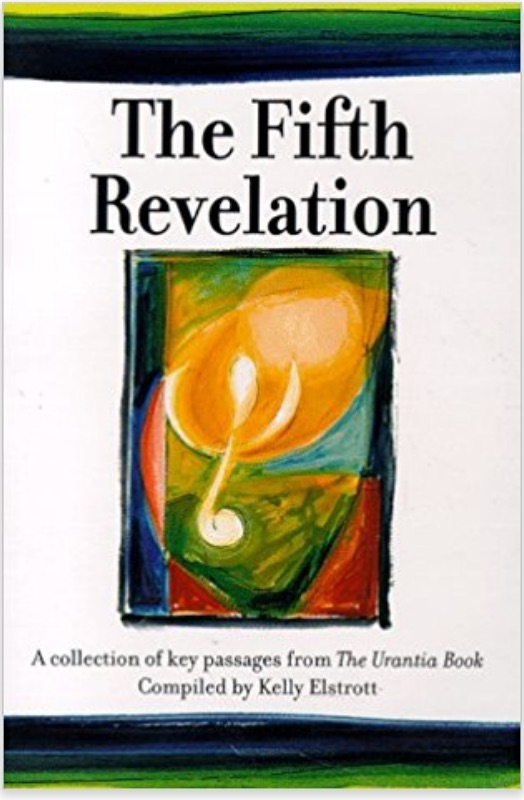
The Fifth Revelation
IntroductionThe morning haze is burning off. Warmed by its heat, the earth silently whirls about the sun. Dreams, those sharp flashing images of sleep, are busily sorting out the previous day’s events. We cast out one thought, file another here, put together a new idea there. A shrill alarm peals through the veil of peace, and groggily we awaken to the reality of a new day— getting the kids ready for school, working, shopping, cooking, cleaning, helping with homework, and juggling the bills.
Caught up in everyday life, we rarely reflect on the long view— that is, the eternal nature of our lives. Do we take time to greet each new day as another treasure, an empty canvas waiting to be filled with a spectrum of thoughts, emotions, and dreams? No. Eternity is nothing more than a notion, kept in a nice, neat compartment called religion. We rarely slow down long enough to ponder life after death. Most of us only come close to considering our mortality in the midst of a difficult life crisis.
Beginning with the disillusionment of the Crusades and continuing through the merciless Inquisition with its heaps of guilt, suppression of knowledge, and archaic laws, religion has acquired a bad name. Today we associate it with TV preachers trying to fill their coffers or mystical gurus brainwashing gullible youths and turning them into flower-selling zombies. Increasing numbers of us relate to religion as a bureaucratic organization more concerned with self-perpetuation than with eternal values.
As society has become disillusioned by the commercialization of religion, science and technology have unexpectedly stepped in the breach and brought us a new vision of infinity and of the magnitude of God’s creation. Telescopes unfold technicolor pictures of the hundreds of millions of galaxies that surround us. One can but stand in awe at the sight of the infinite panorama of these star systems.
Five hundred million years ago, primitive life appeared on our young planet, yet only in the past 3,000 years has humanity sustained a civilization. Our culture is so young. Imagine planets with civilizations as old as our planet. What could their inhabitants have accomplished in a billion years of existence? What have they learned about the universe that surrounds us?
Due to the growing complexity of society, modern man is confronted with the task of making more adjustments in this generation than have been made in the last 2,000 years. A hundred years ago we would have scoffed in disbelief at the idea that pictures and sounds could be transmitted by invisible waves across millions of miles. Projecting 1,000 years into the future, imagine the wonders and forces humanity will discover. It is common in this modern era to envision things we cannot see. We readily accept the existence of microscopic bacteria and invisible radio waves.
Pushing our vision even further, we may wonder, what have we yet to learn about God’s spiritual creatures— those beings we are unable to see due to the limited chromatic band of human eyesight, beings we are unable to communicate with due to our primitive spiritual depth? As we grow up, we become able to handle more advanced concepts.
Similarly, as civilization matures, the image of the universe progresses and expands. It was first believed that human beings were alone in the universe, living on a flat world, and that the sun and stars revolved around God’s only inhabited creation. Finally, much to the dismay of the church, early astronomers dispelled that notion.
Now we know not only that we revolve around the sun but that our sun revolves around the Milky Way galaxy, and that the millions of galaxies in the universe revolve around a dark mass whose weight exceeds that of all the stars. This awareness prompts us to wonder: Could that mass of stars be Paradise? Anthropologists have uncovered fossils revealing the long history of life.
These discoveries prompt another question: Are we simply the products of a long-ago biochemical accident, a lonely freak in an endless, cold universe, here on this hostile world for just a short season?
Astronomers have detected planets surrounding other nearby stars. How many more inhabited planets are out there? Is there a grand plan to this vast creation?
Our religious concepts have been evolving since the dawn of civilization. In ancient times, humanity feared a volcanic pagan god known as Yahweh. Over the past 3,000 years, the belief in God has matured from fear to faith in a Father whom we describe as love. Now we are ready for an even broader concept: a loving Father who develops life on countless planets.
Life, in this sense, is defined as the infinite potential to progress by striving to do God’s will. Indeed, life will appear ever more spiritual and less material as, we work toward the center to embrace the Creator. When we reach the Father, our life is just beginning. We humans are destined to play an integral part in developing the grand universe. The future is not revealed, but we have been assured that our eternity will be far from blissful, or boring. Rather, we can look forward to a challenging eternal life and ever-increasing responsibility.
Enjoy the story of man and the universe as it unfolds in these pages. Here you will learn:
- How the sun broke free from a nebula, and how a later tidal-gravity explosion created the solar system of planets.
- How life, meticulously planned for earth, was planted in the ocean, and how the same salt-solution habitat still circulates through our bodies, submersing every living cell in the “briny deep.”
- How primitive humanity evolved to a point of making free-will decisions, leading to rudimentary concepts of God and of an immortal soul.
- How to understand and master the fickle emotions that race through our animal minds.
- Why families are important, and why our earliest years of life affect our personalities for all eternity.
- How man’s sacred books originated, including the truth about prophets who were routinely killed for trying to broaden popular notions of God, yet later glorified in holy scriptures.
- How Jesus lived before he began teaching— how he shouldered the burden of raising a large family after his father’s untimely death, experiencing the same swing of emotions and everyday challenges we humans encounter and how he became cognizant of his divinity and laid plans for the revelation of God the Father.
- The nature of God and how the cleansing effect of regular, unstructured prayer can bring strength through peace of mind.
- How the heavenly rebellion into which the earth was dragged 200,000 years ago temporarily isolated humanity from the rest of the universe, providing us with special opportunities for insight.
The passages compiled in this volume were excerpted from The Urantia Book, a 2,097 page work first published in 1955. Chapter titles, page and paragraph numbers are included at the end of the selections to help you locate them in the original text of The Urantia Book. The philosophy of living set forth in The Urantia Book seamlessly unites together leading-edge scientific discoveries with uplifting spiritual truths.
For me, it is a constant reminder of how rich and wonderful life is when I follow the guidance of inner spirit. It beckons me to develop a personal living experience of God and to cultivate an ever-new awareness that the kingdom of God is in fact within each of us. Whereas science can point to the mechanics of life and religion can teach us rules of the road, we each have to choose the best paths to take.
The Fifth Revelation was selected as the title of this work because it contains passages from The Urantia Book, which is the fifth epochal revelation of God to the peoples of earth. My discovery of The Urantia Book has not caused me to abandon the religion of my parents. If anything, it has taught me the importance of raising my children in a tradition that stresses faith and love as the focal points of life. Since my little ones may not comprehend the rituals on the altar, I bring them to church with a stack of library books to keep them at peace. They know church is important to me, and that is a start.
The type of religious institution you and I attend is not as significant as the attitude we bring with us. Instead of dwelling on differences between faiths we can begin to explore their similarities. Yes, trade and communications have brought the world materially closer. Science has drawn us intellectually closer. For there to be a lasting peace, however, we now need to become spiritually closer.
When you awaken tomorrow, lie still for a few moments and feel the earth turn beneath you. Absorb the immensity of the creation you live in. Consider that the sun rises every morning to salute you just as it does the most powerful and prosperous human beings on earth. Look upon the fresh day as a new piece of art— a chance to learn from your experiences and build a foundation for your eternal future.